
Blood Pressure Monitor Mistakes That Skew Home Readings

If your blood pressure numbers jump around at home, the monitor may not be the only reason. Small habits, such as a tight sleeve, legs crossed, a rushed reading, or even a cup of coffee, can push your results off course. Most blood pressure monitor mistakes happen before the cuff finishes inflating, which is why mastering the nuances of home blood pressure monitoring is essential for accuracy.
Good home readings help your clinician judge treatment more clearly. They also help prevent one strange number from turning an ordinary day into a panic spiral, and they are the best way to determine if a high clinical reading is caused by white-coat hypertension or an actual health concern. Because these small habits can significantly impact your systolic blood pressure, it is vital to start with the proper setup.
Quick answer: Home blood pressure readings get skewed by poor posture, the wrong cuff size, talking, movement, recent caffeine or nicotine, measuring over clothing, and relying on one isolated reading. Sit still, support your arm at heart level, and take two readings one minute apart.
Table of contents
- Common errors that lead to inaccurate home blood pressure readings
- Proper posture and how to choose the correct cuff size
- Timing mistakes that distort your blood pressure numbers
- Choosing the best automated blood pressure monitor and managing medication
- Establishing a reliable routine for consistent readings
- Final thoughts
- FAQ
Key takeaways
- Selecting the correct cuff size is just as important as the quality of the monitor you use.
- Maintaining proper arm position at heart level, keeping your back supported, and keeping your feet flat on the floor are essential to avoid inaccurate numbers.
- A single reading is less reliable than two or three measurements taken consecutively.
- Never change your blood pressure medicine based on a single high home result.
The biggest errors that change a home reading
An automated blood pressure monitor works by inflating the upper arm cuff to detect pressure changes within the brachial artery. Because the device relies on precise detection, setup matters. If the cuff sits too low, too high, or too loose, or if it is placed over a thick sleeve, the machine may produce inaccurate readings that do not reflect your true health status.
People with hypertension, heart disease, kidney disease, diabetes, or pregnancy-related blood pressure concerns often benefit from home tracking. Yet the clinical value of home monitoring depends entirely on your technique. According to the American Medical Association's guidance on common BP measurement errors, talking, poor cuff fit, and failing to take multiple readings are frequent sources of error.
This quick table shows where readings often go off track.
| Mistake | What it can do | Better habit |
|---|---|---|
| Talking during measurement | Pushes the reading higher | Stay quiet and still |
| Cuff too small | Often reads falsely high | Match the cuff to arm size |
| Arm below heart level | Can raise the number | Rest arm on a table |
| Legs crossed or no back support | Can increase the reading | Sit upright with back supported, feet flat |
| One reading only | Misses normal variation | Take two readings, average them |
The takeaway is simple. A home monitor is only as accurate as the routine around it.
Posture and cuff placement mistakes
Body position changes the result more than many people expect. The NIH review on blood pressure measurement pitfalls points to poor positioning as a major source of error at home and in clinics.
To ensure accuracy, sit in a chair that provides solid back support. Failing to use back support can lead to elevated results because your body compensates for instability. Keep both feet flat on the floor and prioritize a five-minute rest period before pressing start to allow your heart rate to stabilize. While resting, position your forearm on a table so the cuff sits directly at heart level.
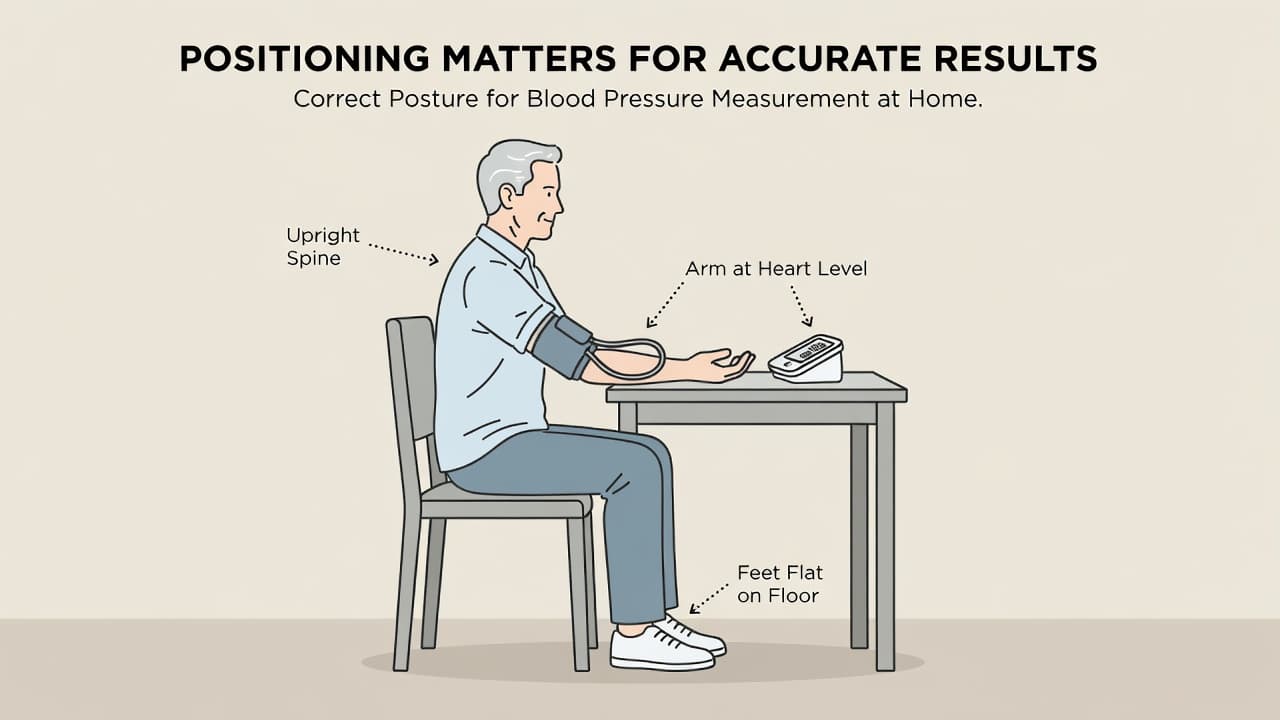
Always use an upper arm cuff on a bare arm, as clothing can interfere with the sensor readings. When applying the cuff, ensure you have the correct cuff size for your body, which is determined by the circumference of your arm directly above the brachial artery. The cuff should feel snug but not painful, with the bottom edge typically resting about an inch above the elbow crease.
Wrist monitors serve as convenient oscillometric devices, but they are significantly more sensitive to placement. If the device is not held exactly at heart level, the reading can drift considerably. Because of this, most medical professionals find that standard upper arm monitors are easier to use correctly for consistent daily tracking.
Finally, pay attention to subtle movements. Do not clench your fist, hunch your shoulders, or hold your arm up without support. Muscles add tension to the limb, and that physical tension can nudge your blood pressure number upward.
Timing mistakes that distort the number
Blood pressure naturally fluctuates throughout the day, which is expected. However, problems arise when you measure your levels during moments that are stacked against accuracy.
Physiological factors play a significant role in your results. Consuming caffeine or nicotine within 30 minutes of a test can artificially elevate your numbers, as can having a full bladder, experiencing pain, or dealing with recent stress. Even common activities like climbing stairs or exercising shortly before sitting down can leave your blood pressure higher than your true baseline. To get the most accurate results, avoid these stimulants and allow for a five-minute rest period in a quiet, chair-supported position before your first measurement.
Timing also matters in relation to your daily schedule and medication. Since many individuals experience a morning surge in blood pressure, checking your levels shortly after waking can provide important data. If you take medication for high blood pressure, consult your doctor about whether you should measure before or after your dose. Consistency is key; establishing a routine where you perform readings at the same times each morning and evening will provide a clearer picture of your health.
Avoid the urge to chase the first number. Clinical practice supports taking repeated readings because blood pressure naturally shifts from minute to minute. Take your first reading, wait about one minute, and then take a second. If the results are significantly different, take a third and average the last two.
Finally, keep your environment calm and avoid talking during measurement. Silence for one minute allows your body to settle, providing a more reliable reading than a distracted, noisy session.
Choosing the right monitor and handling medicine safely
A poor-quality device can introduce unwanted variables, but user error still causes most inaccurate readings. If your monitor is old, the cuff is frayed, or the batteries are weak, your results may suffer. For reliable results, you should prioritize validated devices; you can find a list of clinically approved models at validatebp.org to ensure you are starting with a dependable unit.
If you need a replacement, a standard automated blood pressure monitor is a simple choice for daily checks. These oscillometric devices are designed for ease of use. Some people prefer a home blood pressure monitor with AFIB detection for added rhythm screening. If your clinician requires more comprehensive heart data, a home ECG machine with blood pressure readings may be worth discussing.
Cost matters, but so does the right fit and clinical accuracy. Basic monitors are usually cheaper than models with Bluetooth, memory profiles, or advanced diagnostic features. You should buy the device you can use correctly every week, rather than the one with the longest feature list.
This is where medication mistakes can occur. People who use an online pharmacy for refills sometimes react to a single odd number and start guessing. Do not double a dose, skip a tablet, or restart your prescription medicine based on one home reading. Whether you order prescription drugs online or utilize online medicine home delivery, maintaining accuracy at home must come first.
Access also affects care. The medicine delivery cost to USA may influence where you refill long-term treatment, especially for chronic disease management. Still, shipping fees and refill timing do not change the core rule: always bring a reliable, accurate log to your clinician before making any treatment changes.
This information is for educational purposes only. Consult a licensed healthcare provider before changing medication, treating repeated high readings, or ignoring repeated low ones.
A quick routine for better readings
Establishing a consistent routine is the best way to ensure your readings are accurate and actionable. By following these steps, you can avoid common blood pressure monitor mistakes that often lead to inaccurate data.
- Sit quietly for a five-minute rest period before you begin.
- Empty your bladder first, as a full bladder can cause an unnecessary spike in your numbers.
- Place the cuff directly on a bare upper arm.
- Support your arm at heart level, as keeping the monitor at heart level is critical for an accurate reading.
- Keep both feet flat on the floor and your back firmly against the chair.
- Take two readings, one minute apart, and record both.
Write down the date, time, and anything unusual, such as pain, stress, missed sleep, or caffeine consumption. Maintaining a short log often explains a surprising number much better than memory does.
Final thoughts
A blood pressure monitor does not work in a vacuum. It reacts to your posture, timing, cuff fit, and the small choices made before the measurement begins.
By refining these details, you move closer to clinical accuracy and significantly reduce the frequency of inaccurate readings. When you maintain a consistent home log, you provide your doctor with the data needed to differentiate between true hypertension and white-coat hypertension. Ultimately, better technique gives you a clearer record, a calmer mind, and a stronger, more reliable basis for any conversation regarding your health and treatment.
FAQ
Why is my home blood pressure reading different every time?
It is completely normal for your blood pressure to fluctuate throughout the day. Factors like physical activity, stress levels, caffeine intake, and even the temperature can cause your numbers to change. If you notice significant variations, ensure you are resting for at least five minutes before checking your levels and always follow a consistent procedure.
Should I measure blood pressure over my shirt sleeve?
You should avoid measuring over your clothing. Placing the cuff directly on your bare skin is essential for accuracy. Fabric can interfere with the sensor and lead to an artificially high reading. For the most precise results, roll up your sleeve or remove the garment entirely so the cuff sits firmly against your upper arm.
How many readings should I take at one time?
Most medical professionals recommend taking two or three readings at each session. Start by resting quietly for five minutes, then take your first measurement. Wait one minute between each subsequent reading and calculate the average of the results to get a clearer picture of your current status.
Can I change my prescription medicine after one high reading?
Never adjust your dosage or stop taking your prescription medication based on a single high reading. Home blood pressure monitors are helpful tools, but a single measurement does not provide a complete clinical picture. Always consult with your doctor before making any changes to your treatment plan, as they need to evaluate trends over time before adjusting your prescription.
What type of monitor is best for home use?
Experts typically recommend using an automated, cuff style upper arm monitor. These devices are generally more accurate and reliable than wrist monitors or finger sensors. Look for a device that has been clinically validated for accuracy, and ensure the cuff size is appropriate for your arm to avoid distorted readings.
Is it safe to use an online pharmacy for blood pressure refills?
Using a legitimate, licensed online pharmacy for your blood pressure refills can be safe and convenient, provided you take a few precautions. Always verify that the pharmacy is verified by the National Association of Boards of Pharmacy. Ensure they require a valid prescription from your healthcare provider and that they protect your personal and medical information. When in doubt, consult your doctor to confirm that your chosen online pharmacy meets safety standards.
Why is my home blood pressure reading different every time?
It is perfectly normal for your numbers to fluctuate, as your blood pressure naturally shifts from minute to minute. These variations involve two specific measurements: your systolic blood pressure, which tracks the pressure in your arteries when your heart beats, and your diastolic blood pressure, which measures the pressure in your arteries when your heart rests between beats.
Significant swings in these readings often occur due to movement, talking, poor arm support, caffeine intake, stress, or inconsistent testing times. Additionally, many people experience a discrepancy between their results at home and those taken in a medical setting, which is often attributed to white-coat hypertension. To ensure the most accurate data, use the same chair, the same arm, and the same routine every time you measure. It is always better to compare your averages over a week rather than obsessing over a single reading.
Should I measure blood pressure over my shirt sleeve?
No. You should always place the cuff on a bare arm to get the most accurate results. Placing the cuff over clothing can interfere with the device, as fabric often prevents the sensor from properly detecting the pulse in your brachial artery. Even thin layers of material can change how the cuff compresses the arm, which may lead to an inaccurate reading. If you find removing clothing difficult, try wearing a loose, short-sleeve shirt when you plan to check your blood pressure at home.
How many readings should I take at one time?
It is best to take two readings, separated by at least one minute, and record both results. Relying on a single measurement often leads to inaccurate readings, as your body needs time to stabilize. By capturing multiple numbers, you gain a much clearer understanding of your typical systolic blood pressure and overall cardiovascular status. If your first two results differ significantly, take a third measurement and calculate the average of the last two. One isolated number can easily mislead you, while repeated readings provide a steadier, more reliable picture of your usual blood pressure.
Can I change my prescription medicine after one high reading?
No. One unusual home reading does not prove that your treatment needs to change. Rest, repeat the measurement, and log the result. If your systolic blood pressure remains high or you experience concerning symptoms, contact a licensed healthcare provider before changing any prescription medicine or refill plan. If your readings remain inconsistent or continue to show elevated levels, your doctor may suggest ambulatory blood pressure monitoring to get a more accurate, long-term picture of your cardiovascular health throughout the day.
What type of monitor is best for home use?
Most healthcare providers recommend using an automated blood pressure monitor that features an upper arm cuff. While portable wrist monitors are available, they are often more sensitive to your body position and movement. For most individuals, arm-based oscillometric devices remain the gold standard for consistent, reliable results. Regardless of the brand you choose, ensuring you have the correct cuff size is essential for clinical accuracy. A monitor that fits your arm properly will always perform better than a device loaded with extra features but an improper fit. When shopping, always prioritize purchasing from a reliable source to ensure your device has been validated for home use.
Is it safe to use an Online pharmacy for blood pressure refills?
It can be safe to use an online pharmacy when the provider follows strict prescription requirements, protects your sensitive health data, and utilizes licensed review processes. Whether you prefer local pickup or opt for the convenience of online medicine home delivery, it is vital that you do not let this ease of access replace professional medical follow-up. Maintaining clinical accuracy with your home monitoring equipment provides the necessary foundation for any remote pharmaceutical care. By combining your reliable home data with a clear hypertension classification from your doctor, you ensure that your treatment plan remains both safe and effective.