
How to Travel Internationally With Prescription Medications

Crossing a border with medicine sounds simple until one bottle, one syringe, or one customs rule turns it into a long day. If you need to travel with prescription medications, the safest approach is clear: keep them in original labeled containers, pack them in your carry-on, bring a copy of your prescription, and check the medicine laws for every country you enter or transit through.
Most travel problems happen when people follow airline rules but miss local drug laws. A little planning now can save you from stress at security, customs, or a pharmacy counter far from home.
Short answer: Yes, you can usually travel internationally with prescription medicine. Bring enough for the full trip plus extra, carry written proof of the prescription, declare medical liquids at screening, and verify whether your destination restricts controlled drugs, injectables, CBD products, or large quantities.
Table of Contents
- Key Takeaways
- What to check before you travel with prescription medications
- How to pack prescription medicine for airport security
- Which medications need extra planning
- How refills and replacement medicine work abroad
- How to lower cost and avoid risky overseas purchases
- What to do if security or customs stops your medication
- Conclusion
- FAQ
Key Takeaways
- Keep all prescription medicine in your carry-on, not in checked baggage.
- Leave medicines in their original pharmacy containers whenever possible.
- Bring paper copies of prescriptions, plus a doctor's letter for controlled drugs, injectables, or large supplies.
- Check the rules for every stop on your trip, not only your final destination.
- Plan refills before you leave, especially for insulin, transplant drugs, oncology medicine, and other time-sensitive treatments.
- If you must order prescription drugs online while abroad, use a licensed pharmacy that requires a valid prescription.
This information is for educational purposes only. Consult a licensed healthcare provider and follow the laws of each country on your itinerary.
What to check before you travel with prescription medications
Start with the country rules, not your suitcase. The CDC guidance for traveling abroad with medicine and Travel.State.gov medicine guidance both stress the same point: a drug that is legal at home may be restricted, tightly controlled, or banned somewhere else.
That matters most for opioids, ADHD stimulants, sleep medicines, anxiety drugs, testosterone, and anything with CBD or THC. Airport security may let you board, but customs at the other end can still stop the medication. If your trip includes a connection in another country, check that country too.
Bring enough medicine for the full trip, plus several extra days in case of delays. Weather, missed flights, and lost luggage don't care about your refill date. If you take a medicine that can't be missed, ask your prescriber for a travel letter that lists the generic name, dose, medical need, and how long you will be away.
This quick packing guide helps keep the essentials in the right place:
| Item | Best place | Why |
|---|---|---|
| Daily pills and tablets | Carry-on bag | Lost checked luggage is common enough to plan for |
| Liquid medicine, insulin, creams, and injectables | Carry-on bag | You may need them mid-trip, and screening is easier |
| Prescription copies and doctor's letter | Personal item or passport pouch | You can reach them fast at security or customs |
| Extra backup supply | Split between carry-on and personal item | One lost bag won't wipe out the full supply |
The big lesson is simple: keep medicine close, labeled, and easy to explain.
How to pack prescription medicine for airport security
TSA rules are often friendlier than people expect. According to TSA travel tips, you can bring pills, prescription liquids, creams, insulin, and injectables in your carry-on. Medically necessary liquids can exceed 3.4 ounces, but you should separate them and tell the officer before screening.
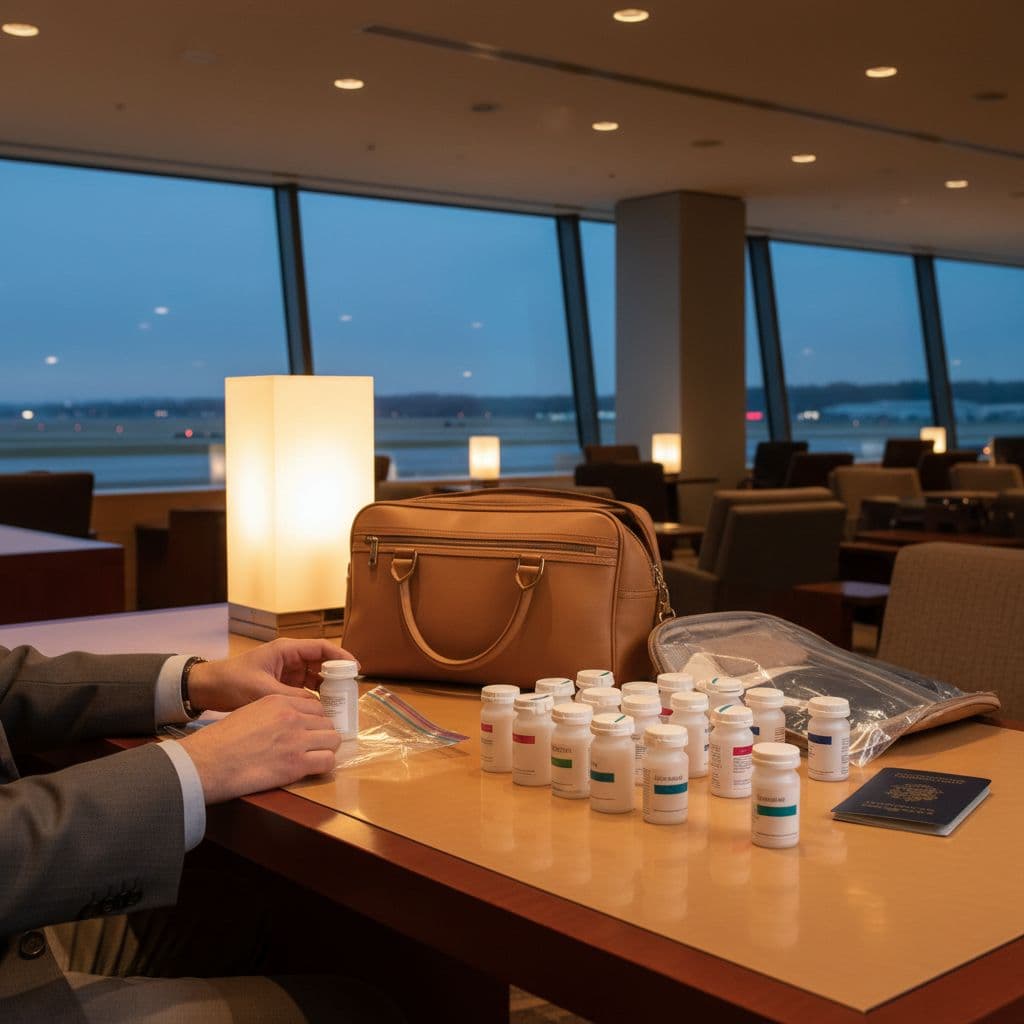
Keep bottles and boxes in original packaging if you can. A clear pharmacy label removes doubt fast. The Harvard travel medication tips make the same point and warn against mixing several drugs into one unmarked pill organizer during transit. You can still use a pill case after arrival, but it should not be your only storage during the flight.
If you use injectable pens, syringes, or sharps, pack them together with your doctor's note. That small folder can save time and awkward questions. The same goes for refrigerated drugs. Use an approved cooling case, but don't bury it deep in checked luggage where temperature control is poor.
Timing matters too. Crossing time zones can shift dose schedules, and that matters for insulin, seizure drugs, birth control, blood thinners, and transplant medicine. Ask your clinician or pharmacist how to adjust your schedule before you leave. Write the plan down. Jet lag makes even simple math feel slippery.
Also, don't pack medicine you may need during the flight in checked baggage. A checked bag is fine for clothing. It is a bad place for something your body depends on.
Which medications need extra planning
Some medicines travel like a paperback book. Others travel like fresh seafood. The difference is not convenience, it is risk.
Controlled substances and sleep medicines
Controlled drugs draw the most attention at borders. That group can include opioid pain medicine, stimulants for ADHD, some anxiety drugs, and some sleep aids. Even codeine can be restricted in certain places. If you take one of these, bring the original container, prescription copy, and a signed medical letter.
Keep the quantity reasonable for personal use. A six-month supply can raise questions even if the medicine is legal. When rules are unclear, contact the embassy or consulate of your destination before you fly.
Injectables, biologics, and specialty treatments
This group needs extra care because storage, timing, and customs questions can all collide. Insulin, fertility drugs, migraine injectables, biologics for autoimmune disease, and many cancer medicines fall into this category.
Immunotherapy drugs for cancer help the immune system attack cancer cells. Targeted cancer therapy drugs block the signals that help tumors grow. Because of that, missed doses, heat exposure, or a rushed switch to a different product can become a real problem. The same is true for immunosuppressant drugs after transplant, which lower immune activity so the body does not attack the new organ.
Caregivers often search phrases like "buy cancer drugs online," "buy immunotherapy drugs online," or "order oncology medicines online" when travel disrupts treatment. The urgency makes sense. Still, this is the wrong time to gamble. Advanced cancer treatment medications, oral chemotherapy drugs, precision oncology medications, and other discounted specialty medications should only come through legal channels tied to your treating team.
A short beach trip with blood pressure tablets is one thing. A month abroad with tacrolimus, insulin, or checkpoint inhibitors is another. The more complex the drug, the more paperwork and planning you need.
How refills and replacement medicine work abroad
Refills are where travel plans often crack. A lost bottle, a delayed return, or an extended work trip can leave you searching for help in a city you barely know. That is when people start looking for an Online pharmacy, an international online pharmacy, or a local clinic that can rewrite the prescription.
That can work, but only if the pharmacy is licensed, requires a valid prescription, and can legally ship or dispense in your location. Before you leave, read online prescription safety for travelers. It covers warning signs that matter even more when you are abroad and rushed.
For longer trips, build a refill plan before departure. Ask your doctor whether you can fill early, carry a larger supply, or get a paper prescription that lists the generic drug name. Generic names matter because brand names change across borders. A medicine you know by one name in the USA may be sold under another name in Australia, the UK, or India.
If you may need delivery while away, look at global pharmacy services for travelers before you need them. A legal service should explain prescription rules, shipping limits, order tracking, and destination-country restrictions. If you still have questions, review traveling with prescription medication support before you fly.
Search terms like "mail order pharmacy international," "online pharmacy with global shipping," and "online pharmacy for travelers with prescriptions" sound helpful, but the real test is boring: Does the seller verify the prescription, show real contact details, and follow the law? If not, move on.
For long stays, some travelers also compare online medicine home delivery and the medicine delivery cost to USA before departure. That is smart planning, especially if family members may need to help with refills while you are away or after you return.
How to lower cost and avoid risky overseas purchases
Travel can turn a normal refill into a financial shock. That is even more true in the United States, where the gap in drug prices in USA vs international pharmacies can be wide. People notice this fast when they need chronic medications, insulin, or oncology treatment.
The search phrases tell the story. People look for affordable cancer medications, cheap prescription drugs worldwide, cheaper prescription drugs from overseas, or an international pharmacy for US patients because local prices can be punishing. Queries like "buy medicines from India online USA" or "global pharmacy shipping USA Australia" also show how often price and access collide.
Cost pressure is real, but risky shortcuts are everywhere. Street markets, social media sellers, and websites that skip the prescription step are bad bets. If someone offers prescription medicine with no paperwork, no pharmacist review, and no clear source, that is a red flag, not a bargain.
Cancer and transplant travelers need extra caution here. The cost of cancer drugs USA vs India can differ sharply, and families often compare generic cancer drugs vs brand products when budgets tighten. That can be reasonable, but only if the substitution is approved by the treating clinician. With oral chemotherapy, immunotherapy, and transplant drugs, a small change in product, storage, or instructions can matter.
If you are trying to figure out how to save on cancer medications or how to reduce cost of long term medications, plan before the trip. Fill early when allowed, ask about approved generic options, carry the generic name, and verify storage needs. For many travelers, that is safer than trying to solve the problem from a hotel room.
A good rule helps here: buy before you board, not after you panic.
What to do if security or customs stops your medication
Stay calm and get your documents out fast. Show the original container, prescription copy, and doctor's letter first. Use the generic drug name if the officer does not recognize the brand name on the label.
Explain the medical need in simple terms. Say how much you are carrying, how long the trip lasts, and when you last took the medicine. If the issue is a liquid, injectable, or cooling pack, say that clearly. Officers deal with these cases often. Clear answers help.
Airport screening approval does not override another country's medicine laws.
If the problem happens at departure, ask whether a supervisor or medical screening officer can review the item. If it happens at arrival, contact your airline, embassy, or travel insurer if the medicine is held. For practical packing reminders, travel safety advice from a pharmacy team also suggests checking refill timing and storage before you leave.
If a medicine is confiscated or delayed, call your prescriber as soon as possible. Do not replace a controlled drug, oral chemotherapy tablet, or transplant medicine with a "similar" product from an unverified seller. When the stakes are high, slow decisions are safer than fast guesses.
Conclusion
Travel goes smoother when your medicine plan is as solid as your flight plan. Keep prescription drugs labeled, close at hand, and backed by paperwork, and most airport and customs problems shrink before they start.
That matters even more for insulin, controlled substances, transplant drugs, and oncology treatment. If you might need refills abroad, line them up before departure and use only licensed pharmacy support. Preparation is what keeps a health routine intact when the map changes.
FAQ
Can I travel internationally with prescription medications?
Yes, in most cases you can. Keep the medicine in your carry-on, use original labeled containers, and carry a copy of the prescription. Also check the rules for every country on your route, because a drug that is legal at home may be restricted at your destination or during transit.
Do prescription drugs need to stay in the original bottle?
Original pharmacy packaging is the safest choice for international travel. It shows the drug name, prescribing details, and your name in one place. A pill organizer is fine after arrival, but during transit it is better to keep the labeled bottle or box with you.
Can I bring liquid medicine over 3.4 ounces on a plane?
Yes. TSA allows medically necessary liquids over 3.4 ounces in carry-on bags. Tell the officer before screening and keep the medicine easy to inspect. This airport rule does not cancel destination-country laws, so you still need to check import restrictions for the country you are entering.
What if I need to order prescription drugs online while abroad?
Use a licensed pharmacy that requires a valid prescription and can legally ship to your location. Do not rely on a site that sells prescription medicine with no verification. If the seller hides its address, skips pharmacist review, or promises miracle savings, walk away.
Is it safe to buy medicine online in another country?
It can be safe, but only with a legal pharmacy. Check that it requires prescriptions when needed, lists real contact details, and follows shipping and import rules. An online pharmacy with global shipping is not trustworthy because of the slogan alone. Licensing and prescription checks matter more.
Can I import medicines for personal use into the USA?
Sometimes, but rules depend on the drug, quantity, source, and purpose. Personal-use imports can still raise legal and customs issues, especially with controlled substances or large supplies. If you plan to bring medicine into the USA, confirm the rules before travel and keep prescription documents with you.
How much extra medication should I pack?
Bring enough for the whole trip plus several extra days. Delays happen often enough to plan for them. If you are taking time-sensitive medicine, ask your clinician whether you can carry a larger travel supply and how to handle dose timing across time zones.
What should I do with refrigerated or injectable medicine?
Pack it in your carry-on with the prescription label and a doctor's letter. Use a travel cooler designed for medication and check how long it holds the right temperature. Never place a drug you may need during travel in checked luggage, where temperature swings and lost bags can create problems.