
CBD drug interactions: Prescription Medicines to Check

CBD can interact with prescription medicines by changing drug breakdown or adding to effects such as drowsiness. Some CBD drug interactions require blood tests or medication adjustments, while others remain theoretical rather than proven in patients.
The strongest evidence concerns particular medicines, including clobazam and warfarin, rather than every drug in an entire class. The distinction between documented effects and possible risks matters when weighing CBD's benefits against an established treatment plan.
Key takeaways
A CBD interaction warning doesn't automatically mean a combination is forbidden. It means the exact medicine, CBD product and monitoring plan need clinical review.
- The anticoagulant discussed below, clobazam, transplant medicines and sedating drugs deserve particular attention.
- CBD gummies and oils can produce systemic effects. Separating doses doesn't guarantee protection.
- Prescribed medicines should never be stopped to make room for CBD. A doctor or pharmacist should assess the combination first.
Table of contents
- How CBD changes medication effects
- Medicines that raise concern
- Product form and dose
- Interaction checks and monitoring
- Warning symptoms
- Access and costs
- Frequently asked questions
- The central safety issue
How CBD drug interactions happen
An interaction can change how much of some medications circulates in the blood. It can also strengthen an unwanted effect without changing drug concentrations.
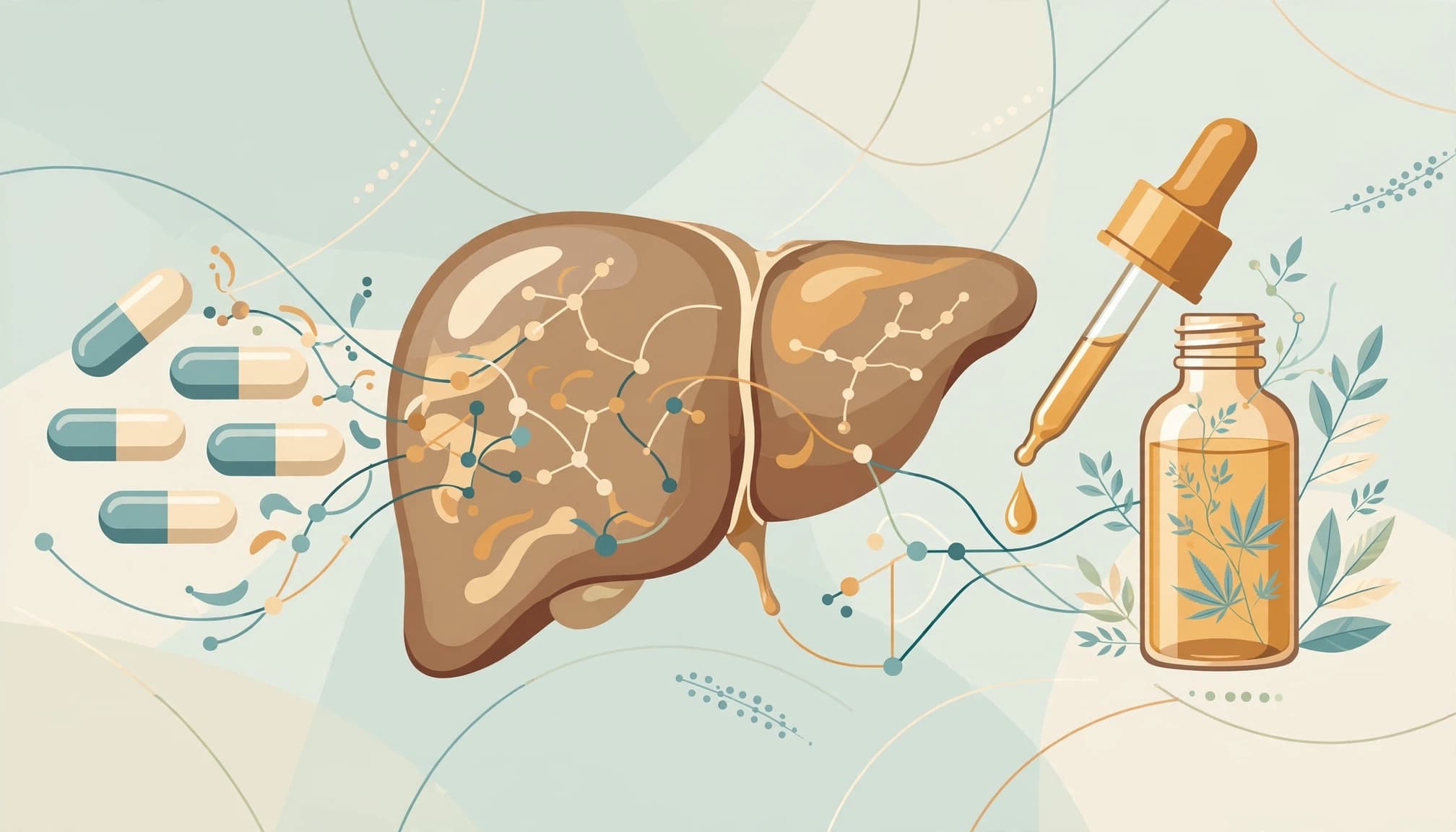
Liver enzymes and the limits of laboratory evidence
The cytochrome P450 enzyme family helps process many prescription drugs. Laboratory studies show that CBD can inhibit enzymes including CYP3A4 and CYP2D6. However, laboratory inhibition doesn't establish the size or clinical importance of an interaction in people.
Other pathways matter too. CBD inhibits CYP2C19, which helps explain its established interaction with clobazam's active metabolite. Depending on the medicine, altered metabolism can increase exposure, reduce conversion into an active substance, or cause an altered concentration in the blood.
Why grapefruit warnings are only a clue
Grapefruit's furanocoumarins inhibit intestinal CYP3A4. As the FDA's grapefruit interaction guidance explains, this can allow more of certain medicines into the bloodstream.
That overlap makes a grapefruit warning a useful reason to request review. However, the "grapefruit test" isn't an official CBD screening method. CBD affects additional pathways, and a medicine without a grapefruit warning can still present a problem.
Which prescription medicines raise concern?
The evidence varies between medicines. A documented interaction, a laboratory finding and a suspected mechanism shouldn't receive identical descriptions.
Blood thinners: warfarin and apixaban
It reduces clotting and requires international normalized ratio (INR) monitoring. A published case report describes an INR increase during CBD dose escalation. Excess anticoagulation can cause serious bleeding.
Apixaban (Eliquis) also prevents blood clots, but the CBD evidence is less direct. Its metabolism and transport create a possible interaction concern; increased apixaban concentrations haven't been established through equivalent clinical evidence. CBD gummies therefore shouldn't be treated as safe additions to either medicine without supervision.
Clobazam and other seizure medicines
Prescription cannabidiol can increase the active clobazam metabolite, N-desmethylclobazam, approximately threefold. The parent drug itself wasn't increased in the cited study. Excess exposure can worsen sedation and may require a clinician-directed clobazam dose adjustment.
Interaction evidence differs across anti-seizure medications. Valproate presents another concern because its combination with prescription CBD increases the risk of liver enzyme elevations. These findings don't mean CBD has no medical role: EPIDIOLEX is an FDA-approved treatment for seizures associated with certain epilepsy syndromes.
Sedating drugs, transplant medicines and cancer treatment
Prescription drugs such as opioids, some antidepressants, antipsychotics and sedating antihistamines warrant review because CBD can add to drowsiness and related side effects. Blood pressure medications may also need a medicine-specific review, but this doesn't mean all drugs in that category interact. Older adults and people taking several sedatives face particular concerns about fatigue, impaired coordination and falls.
Tacrolimus and oral cancer therapies also deserve specialist review. For example, Imbruvica (ibrutinib) medication information concerns a targeted cancer treatment whose CYP3A metabolism makes added substances clinically relevant.
Does the form or dose change the risk?
The route affects absorption, but no formulation guarantees freedom from interactions.
These differences help explain why the exact product belongs in a medication review.
| CBD form | Absorption and interaction considerations |
|---|---|
| Smoked or vaped | Reaches the bloodstream rapidly, often within minutes; inhalation adds separate respiratory risks. |
| Sublingual oil | Absorption varies; some CBD is absorbed through the mouth and some is swallowed. |
| Gummies or capsules | Absorption is slower and variable; food and formulation can change exposure. |
| Ordinary skin creams (topical CBD) | Usually intended for local effects, but systemic absorption can't be excluded for every product. |
| Transdermal products | Designed to deliver substances across the skin and shouldn't be equated with ordinary creams. |
Swallowing CBD oil doesn't make it harmless, and rapid absorption doesn't make inhalation a safer workaround. A systematic review of CBD pharmacokinetics found substantial variation across available human studies.
CBD dosage and frequency also matter. Higher exposure can increase interaction concerns, and uncertain product contents complicate predictions. Risk depends on the medicine, product, and exposure; there isn't a universal starting dose proven safe alongside prescription medication.
How clinicians check and monitor combinations
Share your complete list of medicines and supplements with your prescriber or pharmacist, including each medicine's name and dosage. Bring the CBD product label, strength and formulation, along with the planned amount and frequency. Note when you started CBD or changed its use.

Screening tools identify questions, not automatic bans
Penn State College of Medicine's CANN-DIR cannabinoid interaction resource includes 139 medicines with potential cannabinoid interactions. Its separate list identifies 57 prescription medicines with a narrow therapeutic index, where small concentration changes may matter.
Those figures don't describe 57 proven dangerous CBD interactions. They identify medicines needing careful assessment.
The Medscape Drug Interaction Checker also supports medication and herbal-supplement screening. It adds value when a regimen includes supplements outside CANN-DIR's listed medicines. Neither tool can resolve uncertainty about a particular CBD product or replace professional judgment.
Monitoring depends on the medicine
INR monitoring tracks the blood's clotting response, not a routine measurement of the medicine's concentration. Tacrolimus monitoring measures whole-blood concentrations, usually using a trough sample immediately before the next dose. Other medicines may require blood plasma levels or symptom-based review.
The FDA's EPIDIOLEX prescribing information calls for liver testing before treatment and at one, three and six months, then periodically. That schedule applies to prescription EPIDIOLEX, not every nonprescription CBD user.
Existing liver disease, valproate treatment or abnormal baseline results can require closer monitoring. Starting, increasing or stopping CBD may also change the monitoring plan.
Symptoms that need prompt attention
CBD can cause side effects such as sleepiness, diarrhea, and reduced appetite. After adding CBD, these symptoms may also reflect increased exposure to another medicine.
Unusual bruising, persistent bleeding, black stools, or vomiting blood require urgent assessment, especially during anticoagulant treatment. Severe sleepiness, slowed breathing, or difficulty waking also require emergency care.
Yellow skin or eyes, dark urine, and persistent upper abdominal pain can indicate liver injury. Liver damage shouldn't be dismissed as exceptionally rare.
Symptoms alone aren't a reliable safety test. Some changes appear in blood tests before a person feels unwell, particularly when treatment already requires concentration monitoring.
Safe access and the full cost of treatment
CBD isn't an alternative to prescribed cancer treatment, transplant protection or established chronic-disease care. Its possible benefit should be assessed against the indication, evidence and consequences of disrupting effective treatment.
Local and international prices can differ, but the meaningful comparison includes dispensing, shipping and any additional monitoring. There isn't one standard medicine delivery cost to the USA, Australia or UK. A lower advertised price may offer little advantage after these expenses.
Our Online Pharmacy provides prescription review and pharmacist support. CBD belongs in that discussion even when purchased elsewhere. International sourcing must also meet destination-country import rules and prescription requirements.
This information is for educational purposes only. Consult a licensed healthcare provider before combining CBD with prescribed treatment.
Frequently asked questions
How long should CBD and prescription medicines be separated?
There isn't an evidence-based waiting interval that reliably prevents CBD drug interactions. Enzyme effects and circulating substances can persist beyond the time a dose is swallowed. Taking CBD in the evening and medicine in the morning therefore doesn't establish safety. The combination needs a medicine-specific assessment.
Is there a safe starting CBD dose for someone taking medication?
No universal starting dose has been established for people taking prescription medicines. A low dose may reduce some side effects, but it doesn't remove interaction risk. The relevant factors include the medicine's therapeutic range, liver function, product formulation and whether monitoring can detect a harmful change.
Are over-the-counter medicines safer to combine with CBD?
Over-the-counter medications aren't automatically safe to combine with CBD. Sedating antihistamines, including diphenhydramine, can add to sleepiness, while combination cold products contain several ingredients. However, broad claims that every common painkiller must never accompany CBD overstate the evidence. The exact ingredient, dose and other treatments determine the concern.
Should people taking ADHD medication use CBD?
CBD isn't an established treatment for ADHD. Talk to your doctor or pharmacist for a product-specific interaction review before adding CBD if you take stimulants, atomoxetine or other psychiatric medicines. Sleep problems, anxiety and concentration difficulties also require assessment because CBD-related sedation may complicate symptoms rather than address their underlying cause.
Why might a doctor advise against nonprescription CBD?
A clinician may judge the expected benefit too uncertain compared with interaction risk, liver concerns or inconsistent product contents. That judgment differs from rejecting cannabidiol altogether. Prescription EPIDIOLEX has defined indications, dosing and monitoring, whereas retail CBD products don't have equivalent evidence for every advertised use.
The medicine matters more than the marketing
CBD drug interactions depend on the exact medicine, product and clinical context. Documented effects, such as the clobazam metabolite interaction, deserve a different assessment from theoretical concerns.
The central issue is maintaining effective treatment without avoidable toxicity. CBD's availability as an oil, gummy or cream doesn't settle that question; the medication regimen and the evidence do.