
International Prescription Shipping: Customs Questions to Check

A prescription can be valid, medically necessary, and properly paid for, yet still be delayed or refused at the border. International prescription shipping depends on the destination country's import law, the medicine's legal classification, the amount ordered, and the paperwork accompanying the parcel.
The practical question is simple: can a patient legally import this medicine for personal use, with documents that customs can verify? A clear answer before checkout can prevent an interruption in treatment.
Short answer: International prescription shipping is possible in some circumstances, but personal-use limits, prescription rules, and controlled-drug restrictions differ sharply between the USA, Australia, and the UK. A valid prescription does not guarantee customs clearance.
Table of Contents
- Key takeaways
- Questions to answer before an order
- International prescription shipping rules by destination
- Documents that help customs identify a lawful shipment
- Why the drug type changes the shipping decision
- How to access prescription medicines affordably
- What happens when customs holds a parcel
- Frequently asked questions
Key Takeaways
- Customs authorities look at the medicine, quantity, recipient, origin, and supporting documents together.
- The USA treats personal medicine imports as a narrow enforcement exception, not a guaranteed right.
- Australia generally allows up to a three-month supply per import under its Personal Importation Scheme.
- Controlled medicines need separate scrutiny and may not be suitable for postal import.
- Lower medicine prices do not remove the need for a valid prescription, original packaging, and lawful import paperwork.
Questions to Answer Before an Order
Is the medicine allowed into the destination country?
The first question is not whether a pharmacy can dispatch the order. It is whether the receiving country permits the patient to import that prescription medicine by mail.
Authorities may distinguish between an approved medicine sold locally, a foreign-labelled version of that medicine, and a product unavailable in the destination market. A medicine that is legal in the country of dispensing can still face import restrictions elsewhere.
This information is for educational purposes only and does not replace medical, legal, or customs advice. Patients should consult a licensed healthcare provider and confirm current import rules with the relevant authority before placing an order.
Is the amount clearly for personal use?
Large quantities look commercial, even if the purchaser has no intent to resell. Most personal import frameworks use a three-month supply as an upper boundary, although limits vary by country and medicine class.
Orders should match the prescribed daily dose. A parcel containing several strengths, duplicate therapies, or multiple named recipients often draws more attention than a single clearly labelled treatment course. Before people order prescription drugs online, they should also confirm whether a refill will arrive before the current supply runs out.
International Prescription Shipping Rules by Destination
International prescription shipping rules are country-specific. The same parcel can be acceptable in Australia, delayed in the UK, and refused in the USA.
| Destination | General personal-use position | Main documentation concern | Major caution |
|---|---|---|---|
| USA | Importing drugs is generally illegal, with limited FDA enforcement discretion in some cases | Prescription, doctor letter, personal-use statement | Clearance is not guaranteed |
| Australia | Personal Importation Scheme permits eligible imports | Australian prescription or written authority | Three-month limit per shipment |
| UK | Rules differ for ordinary medicines and controlled drugs | Prescription and clinician letter | Licences may be required for some imports |
For the United States, the Food and Drug Administration has said that personal drug importation is generally unlawful. In limited circumstances, it may use enforcement discretion for a serious condition, a personal-use supply of no more than about three months, and documentation from a U.S.-licensed clinician or evidence of treatment started abroad. Customs officers can still inspect, detain, return, or seize a parcel.
Australia has a more defined framework. The TGA Personal Importation Scheme permits eligible therapeutic goods for personal use or an immediate family member. Prescription-only medicines generally require a valid Australian prescription or written authority. The scheme limits a single import to a three-month supply and limits total imports to 15 months' supply in a 12-month period.
The UK permits some personal medicine imports, but controlled drugs receive stricter treatment. A person bringing certain controlled medicines into the country may carry up to a three-month supply if it was lawfully prescribed and dispensed. Postal imports can involve different licensing questions, so a courier's willingness to ship is not proof of compliance.
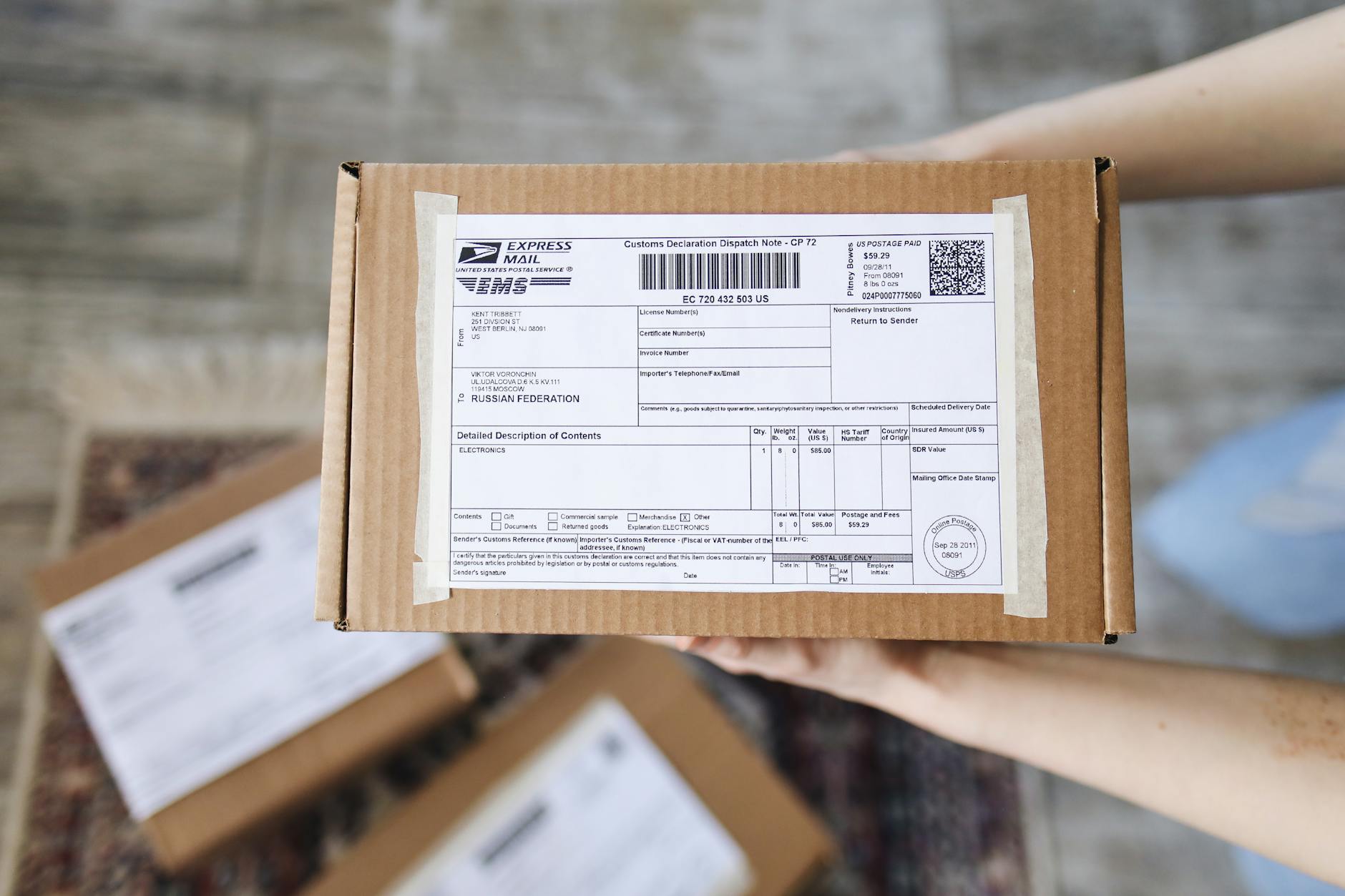
Photo by Polina Tankilevitch
Documents That Help Customs Identify a Lawful Shipment
Match every document to the label
Customs officials need a direct line between the recipient, prescriber, medicine, and quantity. A document packet should use the patient's full name as it appears on the shipping label.
Useful records include:
- A current prescription that states the generic name, strength, dosage form, directions, and quantity.
- A letter from the prescriber that confirms the medicine is for personal treatment.
- The prescriber's professional contact details and, where required, registration number.
- A copy of an identification document when a destination authority asks for proof of personal use.
- An invoice that accurately describes the medicine without misleading declarations.
A prescription written in English can reduce avoidable confusion for USA-bound shipments. For other destinations, translated documentation may be useful when the prescription and package label use another language.
Keep the original packaging intact
Loose tablets in unlabelled containers create a preventable customs problem. Original packaging shows the active ingredient, strength, batch details, expiry date, dispensing pharmacy, and patient instructions.
Australia's consumer guidance on importing medicine advises importers to retain original packaging and labels. It also makes clear that a foreign prescription alone may not satisfy Australia's rules for prescription-only products.
A pharmacy cannot resolve every border decision. However, international pharmacy shipping FAQs can clarify how prescription review, tracking, dispatch timing, and documentation work before an order leaves the dispensing country.
Why the Drug Type Changes the Shipping Decision
Oncology medicines require continuity planning
Cancer treatment is especially vulnerable to customs delays. Patients seeking to buy cancer drugs online should confirm that the prescribed medicine, strength, formulation, and dispensing source match the oncologist's treatment plan.
Oral targeted cancer therapy drugs often block molecular signals that cancer cells use for growth. Cabozantinib, for example, is a tyrosine kinase inhibitor used for certain cancers. Immunotherapy drugs for cancer, including PD-1 or PD-L1 inhibitors, work differently by changing immune checkpoint signalling so T cells can respond to tumour cells.
Those mechanisms do not alter customs law. They do show why an unplanned interruption or unapproved substitution can be serious. A branded product and a generic medicine may contain the same active ingredient, yet the prescriber should review any proposed change in strength, formulation, or manufacturer.
Controlled drugs and cold-chain products need more caution
Controlled substances, including some opioid pain medicines, stimulant medicines, sedatives, and cannabis-based products, face additional restrictions. Australia excludes controlled substances from its usual personal import pathway. The UK also applies separate controls to scheduled medicines.
Injectable biologics can pose a different problem. Some require continuous temperature control, while an international delay can expose the product to conditions outside its labelled storage range. Online medicine home delivery is most workable when the pharmacy, carrier, and patient have a realistic plan for transit time and storage on arrival.
For medicine information beyond a shipping label, MedlinePlus medicine resources explain drug uses, precautions, and side effects in patient-friendly language.
How to Access Prescription Medicines Affordably
Price is often the reason patients look beyond local pharmacies, especially for chronic disease treatment and oncology care. Still, affordability begins with a lawful supply route, not a low advertised figure.
The cost of cancer drugs in the USA vs India or other international markets can differ because of patent status, generic competition, negotiated pricing, distribution costs, and local regulation. Yet the lowest listed price can become misleading after shipping charges, customs delays, replacement costs, and missed treatment time.
The medicine delivery cost to USA should be calculated separately from the medicine price. It may include tracked shipping, temperature-managed packaging, insurance, duties, taxes, and fees charged when a parcel is held or returned.
Generic cancer drugs vs brand products also require a clinical check. Regulators generally require approved generics to meet standards for pharmaceutical quality and bioequivalence, but some treatments have no generic equivalent. An Online Pharmacy should require a valid prescription and identify the dispensing source, rather than presenting international supply as a substitute for clinical oversight.
A lower medicine price matters only if the medicine arrives legally, remains suitable for the prescribed treatment, and does not interrupt care.
For chronic therapy, a refill schedule should allow time for ordinary transit and possible customs review. Patients using long-term blood pressure, diabetes, transplant, or respiratory medicines should avoid waiting until the final tablets remain.
What Happens When Customs Holds a Parcel
A customs hold does not always mean the medicine is prohibited. Authorities may need a prescription copy, prescriber letter, proof of payment, or clarification of the medicine's identity.
The recipient should respond only through official customs or courier channels. Sending altered invoices, inaccurate quantities, or vague product descriptions can turn a documentation issue into a compliance problem.
If the parcel contains time-sensitive treatment, the prescriber should know about the delay. A local pharmacy may be able to discuss lawful bridge options, therapeutic alternatives, or whether a new prescription is needed. Information on how medicine works, side effects, and administration can also be checked through the NHS Medicines A to Z.
Closing Perspective
International prescription shipping can widen access to treatment, but it is not a shortcut around national medicine laws. The soundest orders are limited to personal use, supported by complete records, and planned well before a refill becomes urgent.
For high-cost therapies and long-term care, the strongest safeguard is continuity of treatment. That depends on the prescription, the product, the shipment, and the border rules lining up before the parcel is sent.
Frequently Asked Questions
Can I order prescription drugs internationally?
Some countries allow personal imports under limited conditions, but permission depends on the destination, medicine class, quantity, and documentation. The USA is restrictive and uses case-by-case enforcement discretion. Australia has a formal personal import route for eligible medicines. Controlled drugs often face separate rules.
Do online pharmacies require prescriptions?
A legitimate pharmacy should require a valid prescription for prescription-only medicine. The prescription should identify the patient, medicine, strength, dose, and prescriber. A pharmacy that offers prescription treatment without any prescription review raises safety and legal concerns, especially for international delivery.
Why does customs hold prescription medicine?
Customs may hold a parcel because documents are missing, the quantity appears excessive, the label is unclear, or the medicine falls into a controlled category. A mismatch between the recipient name, prescription, invoice, and package label can also prompt a request for more evidence.
Is it safe to buy medicine online from another country?
Safety depends on the pharmacy's legitimacy, prescription verification, regulated dispensing, product traceability, and compliance with import rules. Patients should verify the active ingredient, strength, expiry date, packaging, and storage needs. Lower prices do not compensate for an uncertain source or unlawful shipment.
Can controlled medicines be shipped internationally?
Controlled medicines can face strict import limits, licensing requirements, or outright restrictions. A lawful prescription does not automatically permit shipping by post. Patients should contact the destination authority and prescriber before arranging any international supply of opioid, sedative, stimulant, or cannabis-based medicines.
What is the safest quantity to order?
A quantity that matches a documented personal treatment plan is least likely to cause concern. Three months is a common ceiling in several jurisdictions, though it is not universal. Orders should never exceed the destination country's limit, and refills should account for customs review and transit delays.