
Accessible Medication Packaging for Everyday Use

A medicine container can become a daily barrier when a label is hard to read or a cap requires painful force to open, especially for people with inflammatory arthritis. Accessible medication packaging combines clear information, tactile cues, manageable opening methods, and safety features so people with low vision or limited dexterity can use prescription medicine more reliably.
Direct answer: Accessible packaging uses large, high-contrast print, raised or tactile identifiers, easy-grip shapes, clear dose organization, and optional audio-enabled digital information. It should also include tamper-evident packaging and child-resistant packaging where required, supporting patient safety.
The strongest designs treat packaging as part of medication safety, not as an afterthought.
Table of Contents
- Key Takeaways
- What Accessible Medication Packaging Looks Like
- Choosing Bottles, Blister Packs, and Calendar Packs
- Balancing Child Resistance With Adult Access
- Smart Packaging for Low Vision
- Safe Online Delivery and Refill Planning
- Frequently Asked Questions
- A Safer Standard for Daily Medicine Use
Key Takeaways
- Clear labels and organized doses can support medication adherence by reducing confusion around medicine identity, dose, and timing.
- Large print alone is not enough. Tactile distinctions and easier grip matter for many patients.
- Calendar blister packs can make a missed or taken dose easier to spot.
- Pill organizers aren't automatically suitable for every medicine, especially for people with inflammatory arthritis or reduced grip strength.
- Child-resistant packaging must protect children while remaining usable for adults.
- Tamper-evident packaging can provide an added safety check. Review package inserts for storage and dosing instructions.
- Digital tools can provide audio information, but they don't replace a regulated label or pharmacist advice.
- Original labeled containers protect traceability, storage instructions, and safer travel.
This information is for educational purposes only and should not replace professional medical advice or individualized patient safety guidance. Consult a licensed healthcare provider or pharmacist before changing how any medicine is stored, opened, or taken.
What Accessible Medication Packaging Looks Like
Accessible medication packaging starts with the tasks a patient must complete. They must identify the product, read directions, open the container, remove the correct dose, take it, and store it safely. Each step can affect medication adherence and the risk of using the wrong product.
Options may include large-print labeling, tactile identifiers, easy-open closures, and talking or audio information. No option suits everyone. Pharmaceutical packaging is part of the medication-use system, and good packaging design connects labels, caps, and container shapes to real patient needs.
Research on older people's experiences with medication packaging describes how ordinary packs can become difficult when strength, vision, memory, or hand movement changes. The answer is not a single "easy-open" cap. Different conditions create different barriers.
Low-vision labels and tactile identification
A readable label needs strong contrast, plain layout, adequate type size, and space between key instructions. The medicine name, strength, directions, and warning statements should not compete with promotional color or dense design.
Large-print labeling can make key information easier to find. Talking labels or audio information may also help, depending on a person's preferences and technology access. Accessible labeling should supplement package inserts, not replace the full manufacturer information.
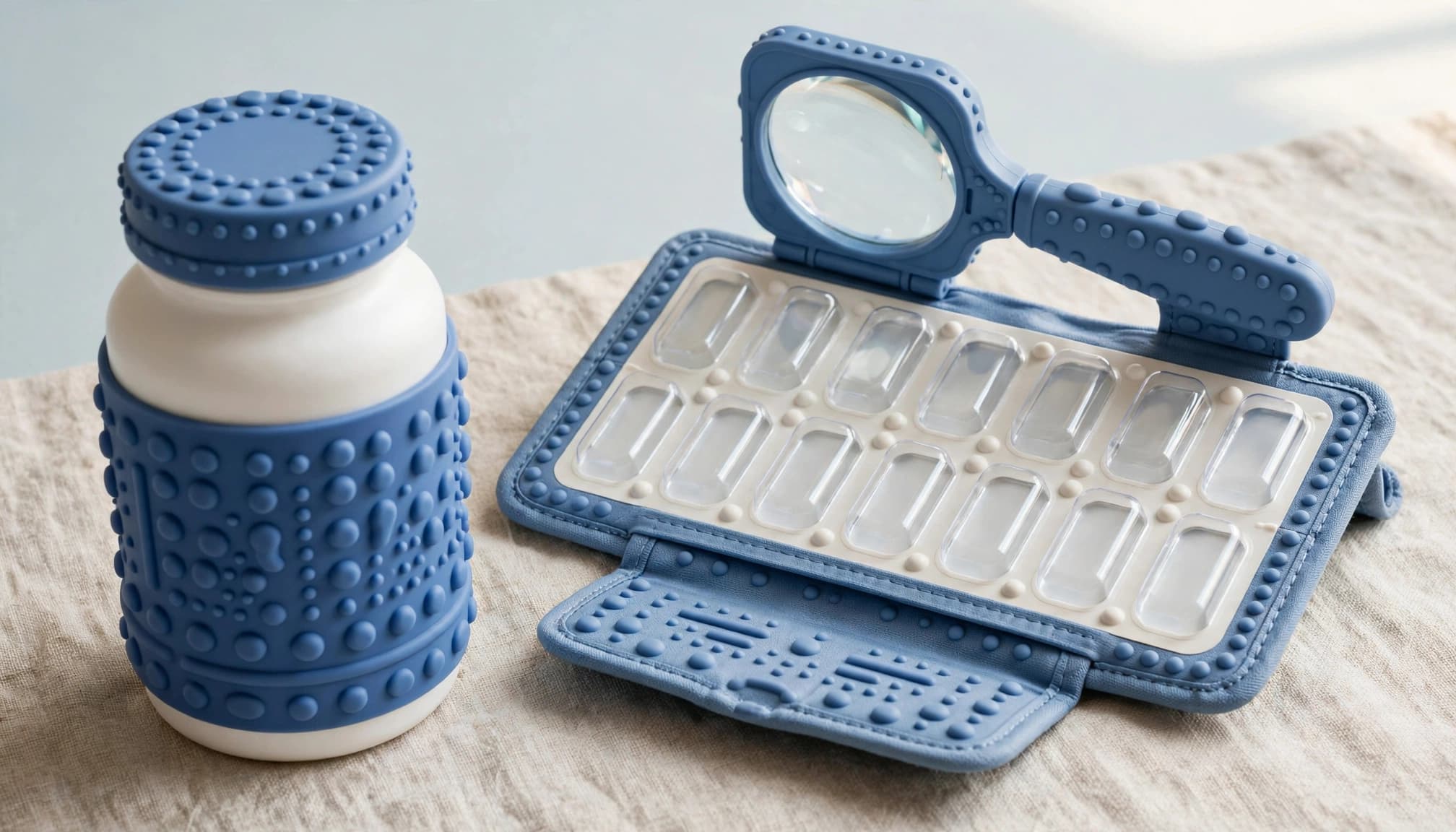
Raised dots, differentiated bottle shapes, textured areas, and distinct cap profiles can help a person tell products apart by touch. Braille can be useful, although it should complement rather than replace large print and audio options because not every person with vision loss reads Braille.
Grip, opening force, and limited dexterity
Inflammatory arthritis, tremor, stroke-related weakness, and reduced grip strength can make a push-and-turn cap painful or impossible. Patients sometimes respond by leaving caps loose, using tools, placing tablets in pill organizers without confirming compatibility, or decanting them into unmarked containers. These workarounds can cause medication errors and compromise patient safety.
Senior-friendly packaging may use a wider bottle, non-slip texture, a larger cap surface, or a closure that needs less twisting force. However, inflammatory arthritis means one closure may not work for every person, and child-resistant packaging can create a barrier. Patients should consult a pharmacist before using an alternative closure, cutting a blister pack, transferring tablets, or defeating a safety feature.
Choosing Bottles, Blister Packs, and Calendar Packs
The best pharmaceutical packaging format depends on drug stability, dosing routines, household risks, and accessibility needs. A person with inflammatory arthritis may need low-force packaging and limited grip strength can affect bottle handling. A simple daily tablet may suit a bottle, while complex schedules may need unit-dose packaging.
| Format | Useful accessibility feature | Main limitation |
|---|---|---|
| Easy-open or wide-grip bottle | Easier to hold and open | Loose doses are harder to track, and closures may not suit child safety |
| Unit-dose packaging | Separates each dose for easier tracking | Foil may require high finger pressure |
| Blister packs | Protects each dose and shows the remaining supply | Can require more storage space |
| Calendar pack | Shows whether a scheduled dose remains | Calendar markings must be readable |
| Strip-pouch packaging | Groups doses by time or routine | Storage conditions may be less obvious |
| Customized pharmacy packaging | Organizes doses by time of day | Requires pharmacist verification and correct storage |
A pack should never be chosen for convenience alone. The format should also reduce medication errors, preserve the medicine, and follow prescribed directions. Some convenience formats still need a compliant child-resistant packaging closure.
Calendar features and medication adherence
Calendar packaging places doses in dated or timed compartments. An intact compartment can indicate that a dose remains, while an empty one may show that it has already been taken.
This visible organization can support medication adherence for people managing several daily medicines, including oral cancer therapies, immunosuppressants, blood pressure treatments, and diabetes medicines. It can also support medication adherence when paired with a written plan, reminder system, or caregiver check-in. However, a calendar cannot confirm that a tablet was swallowed.
Package inserts can explain dosing instructions, storage requirements, and handling precautions. A calendar format works best when those instructions remain available for reference.
Moisture barriers and medicine shelf life
Solid oral drugs can lose stability when exposed to oxygen, light, or poor storage conditions. A suitable moisture barrier helps protect tablets and capsules during dispensing, transport, and home storage. Blister packs often create a separate protected cavity around each dose, while bottles may use desiccants, induction seals, or barrier materials.
Cold-seal blister wallets can reduce the need for difficult push-through foil in some designs. Compared with push-through foil, cold-seal blister wallets may require less finger pressure, which can help someone with inflammatory arthritis. Still, every format must protect the drug through ordinary handling and storage.
Package inserts may warn against removing tablets from their original format before use. Pill organizers can be useful alternatives, but a pharmacist should confirm that they suit the medicine and its storage needs.
Accessible materials should also support sustainable packaging goals. Use the least complex combination of plastic, foil, and paperboard that preserves the medicine and meets safety requirements.
Balancing Child Resistance With Adult Access
Child-resistant packaging is a safety measure, not a promise that every adult can open every package. Many oral prescription and nonprescription products fall under U.S. special-packaging requirements, but the applicable format depends on the product and dispensing setting.
The central challenge is practical: a closure must delay a young child while allowing adults to use the medicine as directed. People with a disability shouldn't be expected to trade independence for household safety.
Standards and regulatory expectations
Together, these regulatory standards address both child resistance and adult accessibility. ISO 8317 standards cover reclosable child-resistant packages, including testing for adult access. EN 14375 standards address non-reclosable pharmaceutical packages, including certain blister formats. In the United States, child-resistant packaging performance requirements sit within the Consumer Product Safety Commission framework.
The FDA's guidance on container labels and carton labeling emphasizes labeling choices that reduce medication errors. Package inserts can reinforce opening instructions and medicine-specific warnings. The guidance also distinguishes some institutional unit-dose packs from outpatient containers, where child-resistant dispensing may be needed.
Human factors testing finds real barriers
Human factors engineering tests packaging with the people expected to use it. Designers should assess grip, orientation, visual access, and opening force. They should also observe dose removal and reclosing without help.
Testing must include older adults, people with reduced grip strength, people with low vision, and people with inflammatory arthritis. Someone with inflammatory arthritis may struggle with opening force even when a closure technically meets a standard. The purpose isn't to produce a universally easy package, which doesn't exist. Good packaging design identifies which features fail people, rather than simply changing the cap shape.
Accessible alternatives may include senior-friendly packaging or pharmacist-selected closures. They should retain tamper-evident packaging and appropriate storage safeguards, supporting patient safety and child protection. Pharmacists can review package inserts and demonstrate safer opening methods before the product reaches a home.

Smart Packaging for Low Vision
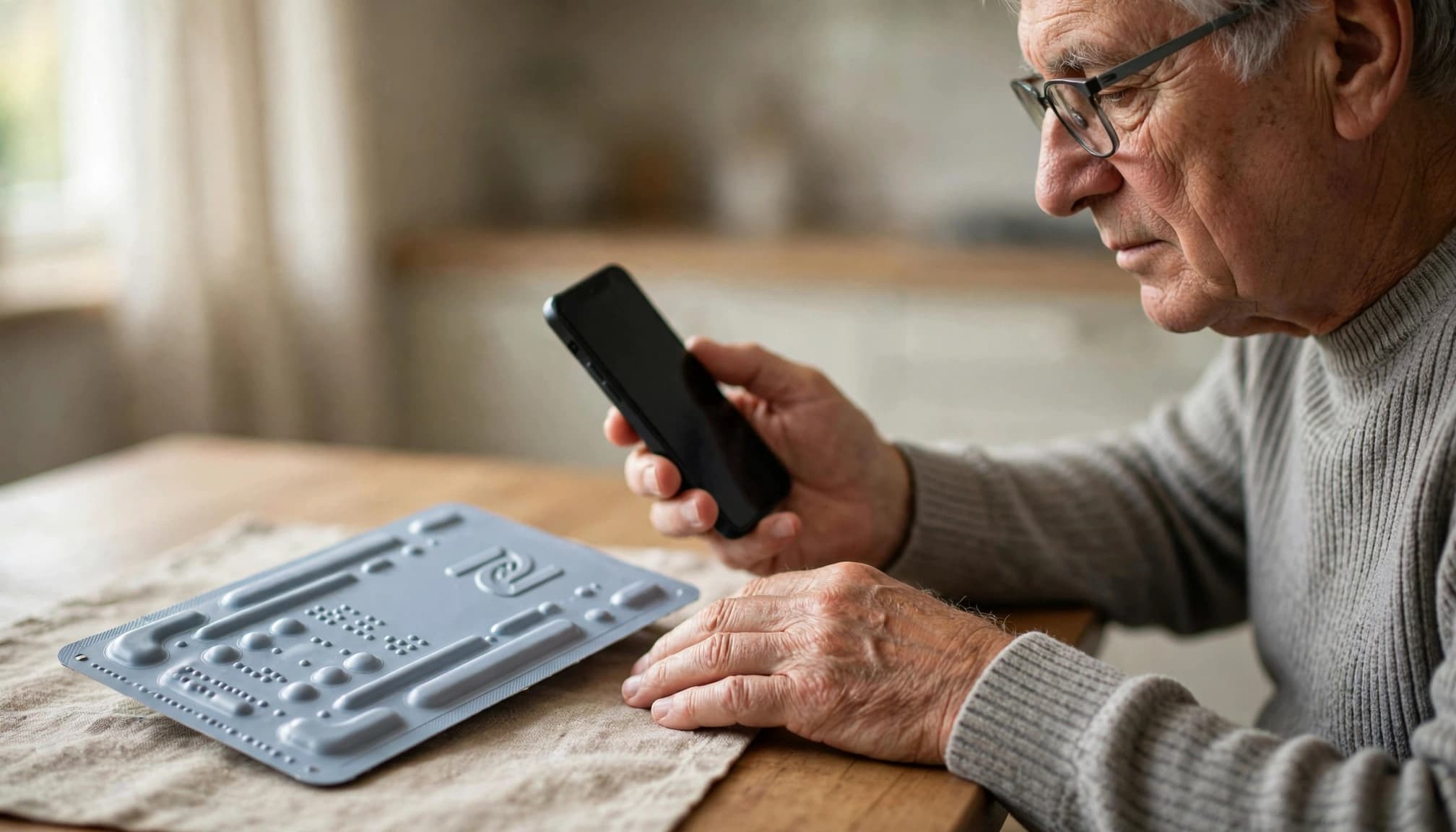
Digital accessibility can provide supplemental access to medicine information for people with visual impairment. A QR code, NFC tag, or accessibility marker can connect a package to spoken instructions, audio product information, large-print guidance, dose reminders, or product verification data.
These tools are most useful when the physical code is easy to locate and the information works with screen readers. They should also work without requiring an account or a complicated display.
NFC, QR codes, and NaviLens
NFC technology works when a phone is brought near a tag. QR codes require a camera scan. NaviLens codes are designed to be detected at a distance, which can make them easier for some people to find.
A well-built digital layer may provide the medicine name, presentation, lot number, expiry date, and an accessible digital version of package inserts. Digital verification should complement tamper-evident packaging, not replace it. These features can also help a caregiver confirm that a package hasn't been confused with another product.
Digital access does not replace the label
A phone can be unavailable, uncharged, incompatible, or difficult to use during an urgent moment. Therefore, the carton and immediate container still need legible core information, tamper-evident features, and clear storage directions.
Digital tools also require privacy safeguards. A code shouldn't expose a patient's diagnosis, prescription history, or identifying information. For complex therapies, package inserts and the pharmacist remain essential sources of counseling.
Safe Online Delivery and Refill Planning
An online pharmacy can improve access for people in remote areas or patients whose mobility makes pharmacy visits difficult. However, medicine home delivery adds responsibility because packaging must remain intact and traceable during shipment.
Before ordering prescription drugs online, confirm that a valid prescription is required and a pharmacist reviews each order. Check that the medicine arrives in its original packaging with child-resistant packaging when appropriate. The seller should also provide clear contact details and follow applicable supply limits.
On arrival, inspect the seal and container for signs of damage or interference, including tamper-evident packaging. Keep the original labels and package inserts with the medicine. Compare the delivered name, strength, directions, and quantity with the expected prescription to help prevent medication errors.
Ordering with accessible needs in mind
Patients or caregivers should tell the pharmacy about low vision, painful hand movement, inflammatory arthritis, or difficulty opening a specific closure before the order is packed. A pharmacist may be able to discuss opening force, an alternative container, adherence packaging, large-print information, or counseling.
The secure prescription ordering steps explain how prescriptions are submitted for review. Timely delivery can support medication adherence and continuity, but it can't replace an individualized dosing plan. If considering pill organizers, ask a pharmacist first whether the medicine can be safely repackaged.
Those using regular refills can also get started with prescription delivery early enough to avoid a last-minute shortage.
Delivery costs and international orders
Medicine delivery cost to USA depends on destination, package size, shipping method, temperature needs, and any customs-related delay. The same variables affect shipments to Australia and the UK, so no single price comparison can show the true cost of prescription medicine.
An international online pharmacy shouldn't encourage removing original labels to reduce shipping weight or simplify customs. International prescription shipping guidance explains why original packs, active ingredient details, expiry dates, and dispensing information matter. For general ordering support, the Online Pharmacy provides information about pharmacist-reviewed services.
Frequently Asked Questions
What does accessible medication packaging include?
Options may include large-print labels, tactile markers, easy-open containers, talking labels, unit-dose packs, blister packs, strip-pouch packaging, and customized pharmacy packaging. The best choice depends on the medicine and the user's vision, hand function, treatment schedule, and household safety needs. A pharmacist can help identify suitable features for a particular prescription.
Can child-resistant packaging still be senior-friendly?
Yes, child-resistant packaging and senior-friendly packaging can coexist, but neither design is universally easy or safe. Larger gripping surfaces, clear opening instructions, and improved package orientation may help. People with limited grip strength or inflammatory arthritis may need an alternative opening method. For patient safety, ask a pharmacist about easy-open closures, child-resistant requirements, and whether a caregiver should assist.
Should tablets be moved into a pill organizer?
Ask a pharmacist before moving tablets from their original container. Original labeling, package inserts, storage instructions, and warnings must remain available. Ask whether the medicine can be repackaged, which packaging protects it from moisture or light, and whether crushing, splitting, or dose removal is allowed. If approved, pill organizers and visible doses can support medication adherence and daily routines, but they don't prove that a dose was taken.
Do online pharmacies require prescriptions?
Legitimate online pharmacies require a valid prescription for prescription-only medicines and verify it before dispensing. They should offer pharmacist support, provide original labeled packaging, and explain delivery procedures. A site that sells prescription medicine without a prescription presents a serious safety concern.
How can patients check packaging before a refill arrives?
Patients should check the medicine name, strength, expiry date, tamper-evident packaging, seal, and instructions as soon as the package arrives. Any damaged seal, unreadable label, or unexpected product should be reported before use. Keeping one accessible storage system also reduces the chance of confusing medicines.
A Safer Standard for Daily Medicine Use
Medication access depends on more than having a prescription filled. Accessible medication packaging makes it easier to identify, open, track, and store medicine while preserving the safeguards that protect children and product quality.
The right format can support medication adherence by making medicine easier to identify, open, track by dose, and store safely. Pharmacist review remains necessary to match packaging with the person’s needs, labeling requirements, and treatment plan.